
Brand Indicators for Message Identification (BIMI) has been available to mainstream senders for several years, yet most organizations still don’t have it. An independent analysis of 13,000 sending domains found that 90.85% had no BIMI record at all, and only 4.57% had a valid one. That gap is not evenly distributed. Some sectors, retail chief among them, are adopting BIMI at a fast clip and reporting measurable gains in trust and engagement. Others, including sectors with the most to lose from impersonation, are barely getting started. For IT managers, email marketers, and brand managers deciding where BIMI sits on the roadmap, understanding this uneven adoption curve is the difference between catching a wave early and playing catch-up later.
The overall adoption picture is smaller than the hype suggests
BIMI is often discussed as though it’s already table stakes for large senders. The data says otherwise. In Validity’s review of real From-header domains, 90.85% had no BIMI record, 4.57% had a valid record, and 4.58% had a record that was technically present but broken. Among the domains that did have BIMI configured, 89.11% also had a valid DMARC record, confirming just how tightly BIMI adoption tracks DMARC enforcement maturity. Separately, Valimail’s 2026 review of email authentication adoption describes the overall landscape as “widespread but uneven”: most recognizable brands have SPF and DKIM published, DMARC awareness has become mainstream, but only a subset of organizations sustain DMARC at enforcement, which is the prerequisite every mailbox provider requires before it will display a BIMI logo. In short, BIMI adoption is still a leading-edge signal, not a default setting, which is exactly why it still confers a competitive edge to the brands that implement it correctly.
Retail is sprinting, and the numbers show why
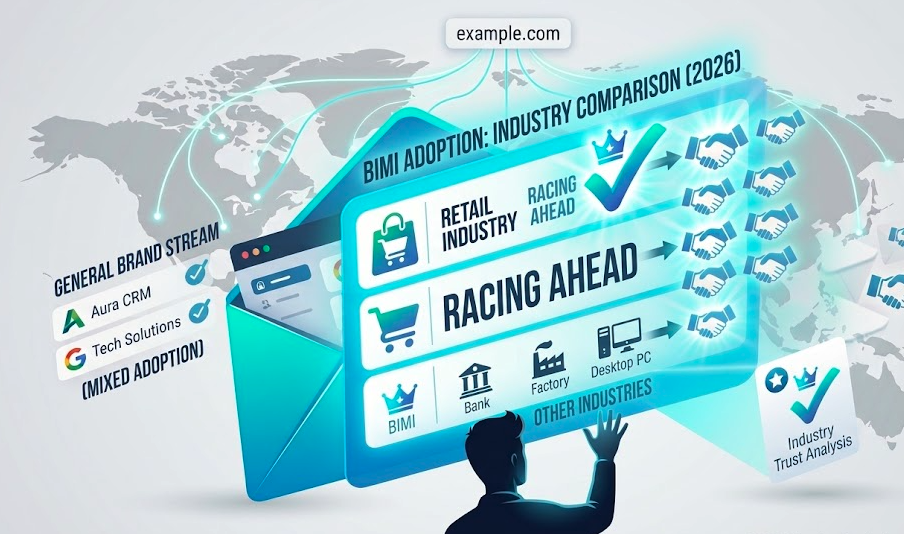
Retail is the clearest sector-level success story. According to Valimail, retail BIMI adoption grew 40% over the course of 2024 alone, a growth rate that outpaces most other verticals. The logic is straightforward: retail inboxes are the most crowded in the consumer world, with dozens of promotional emails competing for attention during any given sales cycle, and average retail open rates hover in the 17%–35% range depending on the source. A verified logo is one of the few remaining ways to win the split-second scan decision before a subject line is even read. Valimail reports that emails carrying a BIMI logo can see open rate increases of up to 20%, and cites named retail adopters such as Mercedes-Benz, AMD, Suzuki, and Zwilling as brands using BIMI to reinforce recognition and reduce impersonation risk simultaneously. Because most retail competitors still haven’t implemented BIMI, early movers in the category are capturing a visual advantage that is currently uncontested.
Financial services, healthcare, and SaaS: highest stakes, slowest starts
The sectors with arguably the most to gain from BIMI, financial services, healthcare, and SaaS, are not moving at retail’s pace. These are B2C categories where recipients already recognize the brand and where a spoofed email carries outsized consequences: a fake bank alert, a fraudulent healthcare portal notification, or a phishing email impersonating a SaaS billing system can cause direct financial and reputational damage. Valimail’s industry guidance specifically flags retail, financial services, healthcare, and SaaS as the categories best positioned to benefit from BIMI, precisely because their customers are primed to recognize and trust a verified logo. Yet these are also sectors with more complex sending infrastructure: multiple business units, numerous third-party vendors, legacy systems, and stricter change-management processes, all of which slow the DMARC enforcement work that has to happen before BIMI is even possible. The result is a paradox where the organizations under the most impersonation pressure are often the furthest from being able to display a verified logo.
The real bottleneck isn’t BIMI, it’s DMARC enforcement
Sector-by-sector adoption differences ultimately trace back to a single technical gate: DMARC policy. BIMI requires a domain’s DMARC policy to be set to p=quarantine (applied to 100% of mail) or p=reject before any major mailbox provider will display a logo. Validity’s domain analysis found that among senders with valid BIMI records, 69.24% were using p=reject and 26.15% were using p=quarantine, meaning over 95% had correctly reached enforcement, a level of DMARC discipline that most organizations across all sectors have not yet reached. This is why adoption clusters around organizations with mature, centralized email security programs. Retail brands, particularly the larger ones publishing BIMI today, tend to run tighter marketing-platform consolidation, which makes reaching DMARC enforcement comparatively simpler than in industries with sprawling, decentralized sending infrastructure.
What the adoption gap means for your sector right now
If your industry has low BIMI adoption, that is not a signal to wait, it’s the opposite. Retail’s 40% year-over-year growth shows how quickly a category can shift from novel to expected, and once mailbox providers and consumers normalize verified logos within a sector, latecomers lose the differentiation entirely and are left simply catching up to a baseline. Gmail’s rollout of Common Mark Certificate support and its blue verified checkmark for VMC holders (now visible on web, iOS, and Android) signals that Google itself is investing in making these visual trust cues more prominent, not less. For brand managers in financial services, healthcare, and SaaS especially, closing the DMARC enforcement gap now positions your organization to be part of the next adoption wave rather than the one playing catch-up after the visual advantage has already been claimed by competitors.
Get ahead of your sector’s adoption curve
BIMI adoption is not uniform, and that unevenness is an opportunity. Whether your organization is in the retail category racing toward a new normal or in a sector still working through DMARC enforcement, the path forward starts with an accurate picture of your current authentication posture. Bimimi.io helps brands navigate VMC and CMC certificate acquisition, DMARC enforcement, and BIMI implementation end to end, so your logo can appear in your customers’ inboxes before your competitors’ does. Visit bimimi.io to assess where your domain stands and start closing the gap.
Sources:
- Rafael Viana, “The BIMI Battle: An Analysis of BIMI Adoption and Implementation,” Validity, Apr 29, 2025 — https://www.validity.com/blog/the-bimi-battle-an-analysis-on-bimi-adoption-and-implementation/
- “How retail brands use BIMI to drive higher email open rates,” Valimail, Sep 11, 2025 — https://www.valimail.com/blog/bimi-retail-email-marketing/
- “The state of email authentication adoption in 2026,” Valimail, Jul 2, 2026 — https://www.valimail.com/blog/email-authentication-adoption/
- “All about BIMI,” BIMI Group — https://bimigroup.org/all-about-bimi/
- “Set up BIMI,” Google Workspace Admin Help — https://support.google.com/a/answer/10911320?hl=en