Knowledge Base
Common Certificates: CMC (Common Mark Certificate) / Unverified Logo
While the Verified Mark Certificate (VMC) represents the pinnacle of brand authentication, the BIMI standard also allows for a more basic implementation using an unverified logo. This is often informally referred to as using a “Common Mark Certificate” (CMC), though it’s more accurate to describe it as a “self-asserted” or “unverified” BIMI setup, as no formal certificate is involved. Understanding this option is useful for planning a phased BIMI deployment.
What is a CMC and why is it a useful preliminary step?
A CMC, or more precisely, a BIMI implementation with an unverified logo, involves publishing a BIMI record in your DNS that points to your brand’s logo without an accompanying VMC to cryptographically verify its authenticity. In this scenario, the brand is simply self-asserting ownership of the logo; there is no validation from a trusted third-party Certificate Authority like DigiCert.
Despite its limitations, this approach can serve as a valuable preliminary step on the path to full VMC implementation for several technical reasons:
- Validating BIMI Configuration: It allows your technical team to correctly configure and publish the BIMI DNS record and test for syntax errors without waiting for the VMC issuance process.
- Testing SVG Logo Compliance: You can verify that your logo file adheres to the strict SVG Tiny P/S format required by the BIMI standard and that it renders correctly.
- Confirming DMARC Readiness: It serves as a final check to ensure your DMARC enforcement policy (p=quarantine or p=reject) is functioning correctly and being honoured by mailbox providers in conjunction with a BIMI record.
Essentially, it acts as a staging or testing phase, allowing you to resolve all technical prerequisites on your end while you proceed with the parallel, more involved processes of trademark registration and VMC acquisition.
The limitations of CMC compared to VMC in terms of trust.
The distinction in trust between a VMC and an unverified logo is not subtle; it is fundamental. The limitations of the unverified approach are significant:
- No Third-Party Verification: This is the core limitation. An unverified logo provides no cryptographic proof that the organisation displaying the logo is the legitimate owner of that trademark. It is a self-declaration, which carries inherently little weight in a security context.
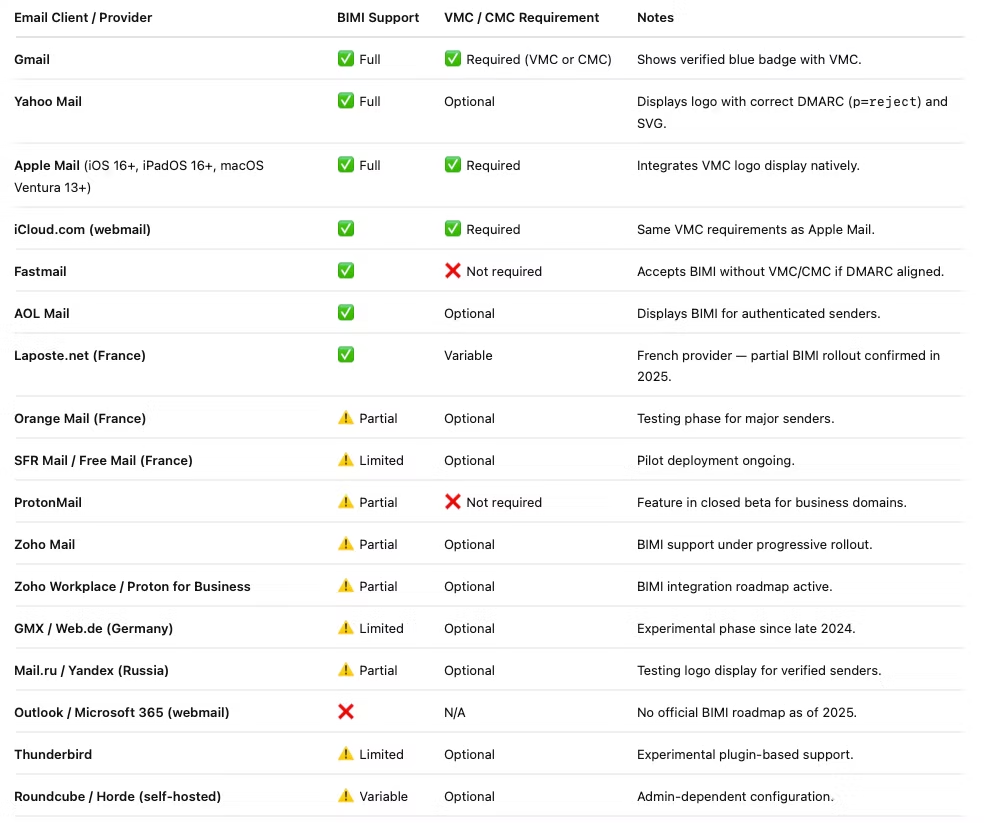
- Inconsistent and Degraded Display: Because of the lack of verified trust, Mailbox Providers (MBPs) treat unverified logos differently. While some may display the logo, they will not give it the same prominence as a VMC-backed logo. For instance, Gmail may overlay the logo with a generic avatar (such as a question mark inside a grey circle) to explicitly signal to the user that the brand’s identity has not been verified. Other MBPs may choose not to display the logo at all.
- Weaker Anti-Phishing Signal: A primary goal of BIMI is to provide a clear, trustworthy visual cue to combat phishing. An unverified, inconsistently displayed logo fails to deliver this benefit effectively. Savvy users may learn to distrust logos that appear without a clear verification indicator, diminishing the value of the implementation.
- Lack of Brand Authority: A VMC demonstrates a brand’s commitment to the highest standards of digital security and authenticity. An unverified logo does not convey this same level of authority and may be perceived as a partial or incomplete implementation.
In summary, while technically functional for testing, an unverified logo fails to deliver the core promises of BIMI: universally recognised trust, consistent brand visibility, and a robust defence against impersonation.
In which cases is a CMC appropriate?
Given its limitations, implementing BIMI with an unverified logo is only appropriate in a few specific, temporary scenarios:
- As a Technical Staging Phase: This is the most common and recommended use case. It allows IT and marketing teams to prepare their infrastructure and assets while the legal and administrative processes for VMC acquisition are underway.
- During Trademark Registration: For organisations that have achieved DMARC enforcement but are still in the months-long process of registering their trademark, this can be an interim step.
- For Internal Testing & Development: It is perfectly suitable for use in non-production environments to test email flows and BIMI record syntax without the need for a formal certificate.
It should not be considered a permanent solution or a long-term substitute for a VMC for any brand that communicates with the public and is serious about building customer trust, ensuring deliverability, and protecting its identity.
Process for implementing a logo without a VMC.
The technical process for setting up BIMI with an unverified logo is straightforward, provided the primary prerequisite is met.
- Achieve DMARC Enforcement (Prerequisite): This step is identical to the VMC process and is non-negotiable. Your domain’s DMARC policy must be set to p=quarantine or p=reject at pct=100. Without this, BIMI will not function in any capacity.
- Prepare and Host Your SVG Logo:
- Convert your logo to the SVG Tiny P/S (Portable/Secure) format. This is a restricted profile of SVG that disallows scripts, external links, and other elements that could pose a security risk.
- Ensure the SVG file is hosted on a public-facing server accessible via HTTPS.
3. Publish the BIMI DNS Record:
- In your domain’s DNS, create a new TXT record.
- The hostname for the record should be default._bimi.yourdomain.com.
- The value of the record will contain two tags: the version (v) and the logo location (l). The a= tag, which points to the VMC, is omitted.
- Example Record:v=BIMI1; l=https://media.yourbrand.com/bimi-logo.svg;
4. Verify Your Configuration:
- Use an online BIMI record checker to validate that your DNS record is correctly formatted and publicly accessible.
- Send test emails to various BIMI-supporting clients (Gmail, Yahoo, etc.) to observe how the unverified logo is displayed. Be prepared for inconsistent results and the potential presence of “unverified” indicators.
By following these steps, you can successfully implement a test-bed for your BIMI deployment. When you are ready to upgrade to full trust and visibility, you will simply acquire your VMC with a partner like BIMIMI and update this DNS record to include the a= tag pointing to your certificate.
The VMC Acquisition Process: Step-by-Step.
Acquiring a Verified Mark Certificate (VMC) is a structured process that combines technical prerequisites with rigorous organisational and trademark validation. This methodical approach ensures the highest level of trust and integrity for your brand’s visual identity. Navigating these steps efficiently is key to unlocking the full power of BIMI.
Eligibility and prerequisite verification (DMARC, registered trademark, SVG logo).
Before initiating the VMC application, a thorough internal review of critical prerequisites is essential. This pre-validation stage significantly streamlines the subsequent CA validation.
- DMARC Enforcement:
- Your email sending domain(s) must have a DMARC record published in DNS.
- The DMARC policy (p=) must be set to quarantine or reject.
- The percentage (pct=) must be 100 (or omitted, which defaults to 100).
- All legitimate email traffic from your domain must pass DMARC authentication (SPF or DKIM with alignment) reliably. This is crucial to avoid legitimate emails being quarantined or rejected once the policy is enforced.
2. Registered Trademark:
- Your brand’s logo must be a legally registered trademark.
- The trademark must be active, valid, and registered with an accepted Intellectual Property Office (IPO) recognised by Certificate Authorities (e.g., USPTO, EUIPO, UKIPO, IP Australia, CIPO).
- Crucially, the logo itself must be registered as a trademark (a “word mark” alone is usually not sufficient for VMC). The logo depicted in your application must be an exact visual match to the registered trademark.
3. SVG Logo Format:
- Your logo must be converted into a specific, secure SVG (Scalable Vector Graphics) format, known as SVG Tiny P/S (Portable/Secure).
- This SVG file must be “clean,” meaning it is stripped of any external references, scripts, or interactive elements that could pose security risks.
- It should be square in aspect ratio (1:1).
- The SVG file must be hosted on a publicly accessible web server over HTTPS. The URL to this SVG will be included in your BIMI DNS record.
BIMIMI offers pre-assessment services to help you verify these prerequisites, ensuring your brand is fully ready for the VMC application.
Submission of the application and required documentation.
Once all prerequisites are met, the application phase begins. This involves submitting detailed information and supporting documents to the Certificate Authority (CA) or via a trusted partner like BIMIMI.
1. Organisational Details:
- Full legal name of your organisation.
- Registered address, contact information, and business registration numbers.
- Details of the VMC subscriber (the individual authorised to apply for and manage the certificate).
2. Trademark Documentation:
- Proof of active trademark registration, including the registration number, date of registration, and the issuing Intellectual Property Office.
- A high-resolution image of the registered logo.
3. Domain Ownership Validation:
- Evidence demonstrating control over the email sending domain for which the VMC is requested. This typically involves placing a specific DNS TXT record or responding to an email sent to an administrative contact for the domain.
4. SVG Logo URL:
- The secure HTTPS URL where your compliant SVG Tiny P/S logo file is hosted.
The application platform (e.g., DigiCert’s portal, or BIMIMI’s streamlined interface) will guide you through uploading these documents. Precision and completeness are paramount to avoid delays.
Validation by the Certificate Authority (DigiCert).
This is the most critical phase, where the Certificate Authority (CA) rigorously verifies all submitted information. For VMCs, this process is akin to the validation for Extended Validation (EV) SSL certificates, involving multiple checks.
- Organisational Validation (OV): The CA will verify the legal existence, operational identity, and physical address of your organisation. This may involve cross-referencing public business registries, databases, and potentially direct contact with your organisation.
- Trademark Validation: The CA will directly communicate with the relevant Intellectual Property Office (IPO) to confirm the active registration and ownership of the trademarked logo. They will ensure the logo submitted matches the registered mark.
- Domain Control Validation: The CA confirms your ownership and control of the specified domain(s).
- BIMI Record Conformance (Optional but Recommended): The CA may also perform checks to ensure your DMARC policy is at enforcement and your SVG logo URL is valid.
- Issuance: Once all validations are successfully completed and confirmed, the CA will issue your Verified Mark Certificate. This certificate contains cryptographic information linking your organisation, domain, and verified logo.
This validation process can take several days to a few weeks, depending on the responsiveness of various entities (IPOs, your organisation) and the complexity of the verification required.
VMC installation: DNS configuration and integration.
Upon successful issuance of your VMC, the final steps involve publishing the necessary DNS records to activate BIMI and integrate your verified logo.
- Receive Your VMC: The CA (or BIMIMI on your behalf) will provide you with the VMC file. This is typically a PEM-encoded certificate chain that you’ll need to link to in your DNS.
- Publish the BIMI TXT Record with VMC:
- You will update (or create) your BIMI TXT record in your domain’s DNS.
- The hostname remains default._bimi.yourdomain.com.
- The record value will now include the a= tag, which points to the HTTPS URL of your VMC file (or chain of files).
- Example Record:v=BIMI1; l=https://media.yourbrand.com/bimi-logo.svg; a=https://media.yourbrand.com/yourbrand-vmc-chain.pem;
- Ensure both the SVG logo and the VMC chain files are hosted on a publicly accessible web server via HTTPS.
3. Verification and Monitoring:
- After DNS propagation (which can take a few hours), use online BIMI validators to confirm that your record is correct and pointing to both your SVG and VMC.
- Send test emails to major BIMI-supporting email clients (Gmail, Yahoo Mail, Apple Mail) to observe your verified logo appearing consistently in the inbox.
- Continue to monitor your DMARC reports to ensure ongoing authentication success, which is vital for BIMI display.
Why choose BIMIMI for your VMC? Expertise, support, and simplicity.
While acquiring a VMC directly from a Certificate Authority like DigiCert is technically possible, the multi-faceted nature of the process – encompassing DMARC readiness, trademark validation, SVG formatting, and complex CA liaison – often presents significant challenges for organisations.
BIMIMI stands as the world’s leading reseller and certified partner of DigiCert, specifically designed to demystify and streamline the VMC acquisition for your brand.
Choosing BIMIMI brings unparalleled advantages:
- Unrivalled Expertise: Our team consists of seasoned email authentication and brand security specialists. We possess deep technical knowledge of DMARC, BIMI, SVG specifications, and CA validation requirements.
- Dedicated, Personalised Support: You gain a dedicated point of contact who will guide you through every single step, from initial eligibility checks to final DNS configuration. We proactively identify potential roadblocks and offer expert solutions, preventing costly delays and frustration.
- Simplified Process: We act as your liaison with DigiCert, handling the intricate communication and documentation requirements. Our bespoke application platform simplifies data submission, ensuring accuracy and completeness.
- Guaranteed Success Pathway: Our rigorous pre-validation services ensure your DMARC is ready, your trademark documentation is accurate, and your SVG logo meets all technical specifications before formal submission, dramatically increasing your success rate.
- Optimised for Efficiency: We leverage our partnership with DigiCert to expedite validation where possible, ensuring a swift and efficient VMC issuance without compromising on security.
- End-to-End Solution: From initial consultation and DMARC health checks to VMC acquisition and ongoing BIMI monitoring advice, BIMIMI offers a comprehensive suite of services.
- Competitive Advantage: By partnering with the world’s best reseller, you not only secure your VMC efficiently but also gain a strategic advantage in implementing a cutting-edge email security and brand trust solution.
Elevate your brand with a verified logo that commands trust. Choose BIMIMI as your trusted partner for a seamless, expertly guided VMC acquisition experience with DigiCert. Contact us today to secure your digital brand identity.
Understanding Certificates: VMC (Verified Mark Certificate)
Having established the foundational role of DMARC, SPF, and DKIM in email security, we now turn to the pinnacle of visual brand authentication: the Verified Mark Certificate (VMC). The VMC is the digital credential that formally links your authenticated email domain to your official, registered brand logo, enabling its display within the recipient’s inbox via BIMI.
What is a VMC and its fundamental difference from a CMC?
A Verified Mark Certificate (VMC) is a specialised type of digital certificate that publicly verifies the authenticity and ownership of a brand’s logo. Issued by a trusted Certificate Authority (CA), like DigiCert, a VMC binds an organisation’s legitimately registered trademark logo to its email sending domain, ensuring that only the rightful owner can display that logo in BIMA-enabled inboxes.
The fundamental difference between a VMC and what is sometimes referred to as a CMC (Common Mark Certificate) – or more accurately, simply displaying an unverified logo – lies in the level of verification and trust.
- VMC (Verified Mark Certificate):
- High Assurance: Requires rigorous validation by a CA, including proof of ownership of a legally registered trademark for the logo.
- Trust Anchor: Provides cryptographically verified proof that the logo belongs to the sender, offering the highest level of trust and confidence.
- BIMI Enabled: Essential for displaying a brand logo in VMC-supporting email clients (e.g., Gmail, Yahoo Mail, Apple Mail). It ensures the logo is visually prominent alongside the sender’s email.
- Compliance: Fully compliant with the strictest requirements of the BIMI standard.
- CMC (Common Mark Certificate) / Unverified Logo:
- Low/No Assurance: This term is often used informally to refer to displaying a logo without the formal verification of a VMC. It might involve simply linking to an SVG file from a DNS record.
- Limited Trust: Offers no cryptographic proof of logo ownership or authenticity. The logo is not formally validated by a trusted third party.
- Limited Display: Its display in inboxes is less consistent, often limited to specific clients or requiring simpler, less secure authentication. It lacks the universal visual “blue tick” of trust that a VMC provides.
- Non-Compliant: Does not meet the full, stringent requirements for universal BIMI display across all supporting email clients, particularly those that demand VMC for full logo prominence.
In essence, a VMC transforms a simple image into a legally and cryptographically verified brand asset within the email ecosystem, a capability entirely absent with an unverified logo.
Why is the VMC the “Holy Grail” of visual authentication?
The VMC is unequivocally considered the “Holy Grail” of visual authentication for several compelling reasons:
- Unassailable Proof of Ownership: It provides immutable, third-party verified proof that your organisation genuinely owns and has the exclusive right to use the logo displayed. This level of assurance is unmatched in digital brand presentation.
- Combatting Deepfake Identity Fraud: In an era where sophisticated AI can generate convincing fake brand assets, the VMC acts as a critical countermeasure. It’s not enough for an attacker to simply replicate your logo; they cannot obtain a VMC for it without owning the registered trademark, making it nearly impossible to display a verified fake.
- Universal Recognition by Email Clients: Email clients that support BIMI (such as Gmail, Yahoo, and Apple Mail) have embraced VMCs as the gold standard. They grant prime visual real estate to VMC-backed logos, often displaying a “verified” indicator, because they trust the underlying validation process. This ensures broad and consistent logo display.
- Elevated Brand Trust and Authority: For recipients, a logo backed by a VMC is a clear, unequivocal signal of legitimacy. It instils a profound sense of trust, distinguishing your genuine communications from the pervasive noise of spam and phishing. This translates directly into enhanced brand authority and credibility.
- Symbol of Digital Maturity: Implementing VMC signifies that your brand is at the forefront of digital security and brand protection, demonstrating a commitment to safeguarding both your identity and your customers. This positions your organisation as a leader in email integrity.
For these reasons, the VMC is not merely a component of BIMI; it is the ultimate enabler of trusted visual identity in the inbox, a true hallmark of digital authenticity.
The exclusive advantages of VMC: maximum trust and instant recognition.
The benefits conferred by a VMC extend significantly beyond basic logo display, offering distinct advantages that elevate brand interaction:
- Maximum Trust & Credibility: The primary advantage is the profound level of trust it engenders. Knowing that a logo is verified by an independent Certificate Authority like DigiCert, and linked to a registered trademark, reassures recipients that the email is legitimate and the sender is who they claim to be. This significantly mitigates phishing concerns.
- Instant Brand Recognition: In crowded inboxes, the verified logo provides immediate, unequivocal brand recognition. This visual cue enables recipients to quickly identify trusted emails, improving open rates and fostering a more efficient and positive user experience.
- Enhanced Engagement & Conversion: When recipients trust the sender, they are more likely to open, read, and engage with the email content. This heightened trust directly contributes to improved click-through rates and, ultimately, better conversion metrics for marketing campaigns and transactional communications.
- Stronger Anti-Phishing Defence: VMCs make it substantially harder for phishers and spoofers to impersonate your brand visually. An attacker cannot obtain a VMC for your trademarked logo, meaning their fraudulent emails will arrive either without any logo or with a generic placeholder, making them much easier for recipients to identify as illegitimate.
- Compliance with Evolving Standards: As email security standards continue to mature, VMCs are becoming the gold standard for verified brand identity. Early adoption ensures your brand remains compliant and positioned to benefit from future enhancements in email client support.
- Competitive Differentiation: By demonstrating a commitment to this high level of email security and brand verification, organisations with VMCs gain a significant competitive edge, projecting an image of professionalism and reliability that distinguishes them from less secure counterparts.
These exclusive advantages underscore why a VMC is not just an upgrade, but a strategic investment in your brand’s digital future.
What are the requirements for obtaining a VMC? (Registered trademark, strict DMARC, etc.).
Obtaining a VMC requires adherence to several stringent criteria, ensuring the highest level of validation and trust. These requirements are put in place by Certificate Authorities and the BIMI Working Group:
- Strict DMARC Enforcement: Your domain must have a DMARC policy set to p=quarantine or p=reject with a pct=100 (or pct omitted). This is non-negotiable, as it demonstrates your domain’s full commitment to preventing unauthorised email sending.
- Valid Registered Trademark: Your brand’s logo must be a legally registered trademark. This registration must be active and valid in the jurisdiction(s) where your primary customers reside or where your business operates significantly. The logo in the VMC must be an exact visual match to the registered trademark.
- Approved Trademark Office: The trademark must be registered with an accepted Intellectual Property Office (IPO) that is recognised by the Certificate Authority (e.g., USPTO, EUIPO, UKIPO, IP Australia, CIPO).
- SVG Logo Format: The logo file must be in a specific, secure SVG (Scalable Vector Graphics) format. This SVG file needs to meet precise technical specifications, including:
- Being “stripped” of scripts and external references to prevent security vulnerabilities.
- Having a square aspect ratio.
- Being hosted securely via HTTPS on your web server.
5. Organisational Verification: The applicant organisation itself must undergo a robust validation process, similar to that for an Organisation Validation (OV) or Extended Validation (EV) SSL certificate. This verifies the legal existence, operational identity, and physical address of the company.
6. Domain Control Validation: Proof of control over the domain for which the VMC is being requested is also required, typically through DNS TXT records or email-based validation.
Meeting these prerequisites is crucial for a successful VMC application. BIMIMI provides expert guidance and pre-validation services to help you navigate these stringent requirements seamlessly.
Where to obtain your VMC? BIMIMI, your certified DigiCert partner.
Acquiring a Verified Mark Certificate (VMC) is a process that demands precision, expertise, and a deep understanding of both cryptographic standards and trademark law. It’s not a self-service endeavour; VMCs must be issued by a trusted, publicly recognised Certificate Authority (CA).
DigiCert is a leading, globally trusted Certificate Authority, and one of the primary issuers of VMCs. Their rigorous validation processes ensure the highest standards of digital trust.
However, navigating the VMC application directly with a CA can be complex and time-consuming, particularly given the stringent technical and legal requirements. This is precisely where BIMIMI excels.
BIMIMI is proud to be a certified and preferred partner of DigiCert for VMC issuance. We stand as the world’s leading reseller because we simplify this intricate process for you:
- Streamlined Application: We offer a guided, step-by-step application process, cutting through the complexities of CA requirements.
- Expert Pre-validation: Our specialists will help you review your DMARC compliance, trademark registration, and SVG logo format before submission, significantly reducing delays and rejection risks.
- Dedicated Support: You benefit from personalised support from our team of BIMI experts, who are on hand to answer all your questions and assist with any challenges throughout the journey.
- Competitive Pricing: As a high-volume, strategic partner, BIMIMI is able to offer exceptional value and competitive pricing for your DigiCert VMC.
- End-to-End Solutions: From initial assessment to VMC issuance and ongoing guidance for BIMI implementation, BIMIMI provides a comprehensive, end-to-end service, ensuring a smooth and successful deployment.
Do not navigate the complexities of VMC acquisition alone. Partner with BIMIMI, the industry’s most trusted and experienced provider, to secure your brand’s visual identity with a DigiCert VMC and unlock the full potential of BIMI. Contact us today to begin your journey towards unparalleled email trust and recognition.