
When brands talk about BIMI, the conversation almost always centres on marketing campaigns — newsletters, promotional emails, seasonal offers. That focus makes sense. But it leaves a significant opportunity on the table.
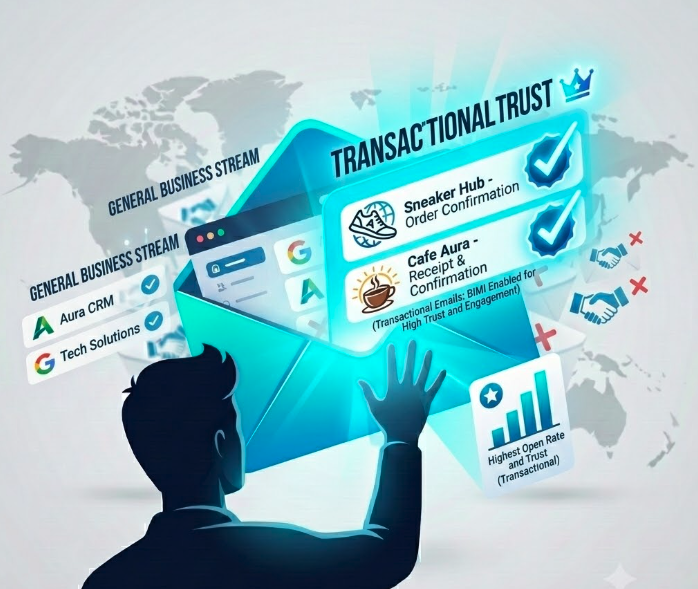
Transactional emails — order confirmations, shipping notifications, password resets, account alerts — are opened at rates three to eight times higher than marketing emails. They arrive at high-stakes moments in the customer journey. And yet, most brands have never thought to apply BIMI to them. This article explains why they should, and how to do it.
Why Transactional Emails Are the Right Place for BIMI
Transactional emails carry an inherent advantage that promotional messages don’t: the recipient is already expecting them. A customer who just placed an order will open that confirmation email. A user who requested a password reset will click through immediately.
This makes them prime phishing targets. Fraudsters know that “Your order has shipped” or “Reset your password” messages bypass the scepticism users apply to promotional content. Brand impersonation attacks frequently exploit these templates, mimicking the visual style of legitimate transactional email to steal credentials or payment data.
BIMI addresses this directly. By displaying your verified brand logo in the inbox — before the email is even opened — it gives recipients an immediate, authenticated visual confirmation that the message is genuinely from you. For transactional email, that signal is not just a brand asset. It is a security guarantee.
The Technical Reality: BIMI Applies to Every Sending Domain
BIMI is a domain-based standard. It doesn’t distinguish between marketing email and transactional email at a conceptual level — it applies to whatever domain appears in the From header. The requirements are the same regardless of email type:
- DMARC must be in place at p=quarantine or p=reject, with pct=100
- Either SPF or DKIM must align with your From domain (DKIM alignment is strongly recommended for reliability)
- A BIMI DNS TXT record must be published at default._bimi.[yourdomain.com]
- An SVG Tiny P/S logo file must be hosted on your domain
- A VMC or CMC must be obtained from an authorised Certificate Authority (DigiCert, GlobalSign, or SSL.com)
The complication is that most organisations send transactional email from a different domain or subdomain than their marketing email. A company might send newsletters from mailto:[email protected], but order confirmations from mailto:[email protected] — using an entirely separate ESP or infrastructure like SendGrid, Amazon SES, or Postmark.
Each sending domain or subdomain needs its own BIMI configuration. This is where most teams get stuck — or simply don’t realise there is work to be done.
Configuring Your Transactional ESP for BIMI
The good news is that the major transactional email platforms fully support BIMI-compliant sending — they just require proper setup on your side.
SendGrid (Twilio): SendGrid does not natively manage BIMI, but emails sent through an authenticated domain in SendGrid can be BIMI-compliant. You must configure Domain Authentication in SendGrid (which sets up DKIM signing for your domain), then separately configure DMARC and your BIMI DNS record on your domain. Once domain authentication is active and DMARC enforcement is in place, SendGrid-sent emails will display your logo in supported inboxes.
Amazon SES: AWS provides dedicated BIMI documentation. You must verify your sending domain in SES, enable DKIM using Easy DKIM or BYODKIM, and set DMARC to enforcement mode. Amazon SES supports both VMC and CMC-based BIMI records. A BIMI TXT record is then published in your DNS, and SES handles the rest within its delivery pipeline.
Postmark, Mailgun, and others: The same pattern applies. These platforms allow domain-level DKIM signing and custom return-path domains, which enable DMARC alignment. BIMI sits entirely in DNS and your certificate setup — the ESP does not need to “support” BIMI directly, it simply needs to sign your emails correctly.
One important note: if your transactional emails come from a subdomain (e.g., orders.brand.com), you can publish a subdomain-specific BIMI record at default._bimi.orders.brand.com. This lets you maintain separate BIMI configurations for different business units or platforms without disrupting each other.
The Subdomain Strategy for Multi-Stream Senders
Many enterprise brands send from multiple domains or subdomains — one for marketing, one for transactional, one for HR or internal communications. BIMI handles this through subdomain scoping.
You can publish a BIMI record at the organisational domain level that applies broadly, or publish specific records per subdomain. This matters when:
- Different business units use different ESPs
- A subdomain has a distinct DMARC policy from the root domain
- You want to display different logos for different product lines
The key constraint: BIMI looks up the record based on the domain in the From address. The DMARC record that governs that domain must also be at enforcement level. If your subdomain inherits DMARC from the root domain (which it does by default unless overridden), make sure the root DMARC policy is p=quarantine or p=reject before you publish any BIMI record.
Getting this architecture right early prevents configuration conflicts as your email infrastructure scales.
The ROI Case Is Stronger Than You Think
Transactional emails consistently outperform promotional emails on every engagement metric. Industry data from Litmus and Validity confirms that transactional messages are among the most trusted and most opened email types. Applying BIMI to these messages means your verified logo reaches customers at the exact moments when trust is most important — and when they are most likely to notice it.
For IT managers, the argument is security: BIMI makes it harder for phishing campaigns to convincingly impersonate your brand in the channels where customers are most vigilant. For marketers and brand managers, the argument is consistency: every customer touchpoint, from promotional email to order confirmation, now carries the same verified visual identity.
Brands that implement BIMI across their full email programme — not just their marketing stack — will have a significant advantage in inbox differentiation as BIMI adoption accelerates across the industry.
Getting Started
If you have already deployed BIMI for your marketing domain, the path to transactional coverage is shorter than you might expect. The certificate and logo you have already obtained can often be reused. The primary work is validating DMARC enforcement on your transactional sending domains, ensuring DKIM alignment through your ESP’s domain authentication settings, and publishing the BIMI TXT record for each domain.
If you are starting from scratch, bimimi.io offers VMC and CMC certificates from leading Certificate Authorities, with expert guidance on the full deployment process. Whether you are managing a single domain or a complex multi-stream sending infrastructure, getting every sending domain BIMI-ready is the next frontier of brand trust in email.
Visit bimimi.io to explore certificates and implementation support.
Sources
- SendGrid / Twilio — Overview of BIMI and SendGrid: https://support.sendgrid.com/hc/en-us/articles/15263626617371-Overview-of-BIMI-and-SendGrid
- Amazon Web Services — Using BIMI in Amazon SES: https://docs.aws.amazon.com/ses/latest/dg/send-email-authentication-bimi.html
- BIMI Group — FAQs for Senders and ESPs: https://bimigroup.org/faqs-for-senders-esps/
- Litmus — What Is BIMI and Why Should Email Marketers Care: https://www.litmus.com/blog/what-is-bimi-and-why-should-email-marketers-care
- Mailgun — BIMI Email Specification: Technical Tips for DNS Record Setup: https://www.mailgun.com/blog/deliverability/bimi-more-than-funny-name/