
VMC vs CMC vs BIMI: What’s the Difference?

If you are comparing BIMI, VMC and CMC, the first thing to understand is that they are not the same thing. BIMI is the email logo framework. VMC and CMC are the certificate paths used to validate your logo for BIMI. This page helps you understand the differences, compare requirements and choose the right option for your brand.
BIMI is the framework that enables a brand logo to appear in supported inboxes. A VMC is the premium certificate path for trademarked logos and is the route tied to the Gmail verified checkmark. A CMC is the more accessible certificate path for eligible logos validated through prior use rather than trademark registration. Google recommends using a VMC when possible.
Key Facts
- BIMI is the framework, not the certificate.
- To use BIMI in Gmail and other inboxes, you need a VMC or CMC, plus DMARC and compatible hosting.
- A VMC is for trademarked logos and is the more rigorous certificate path.
- A CMC is the more accessible path for eligible prior-use logos.
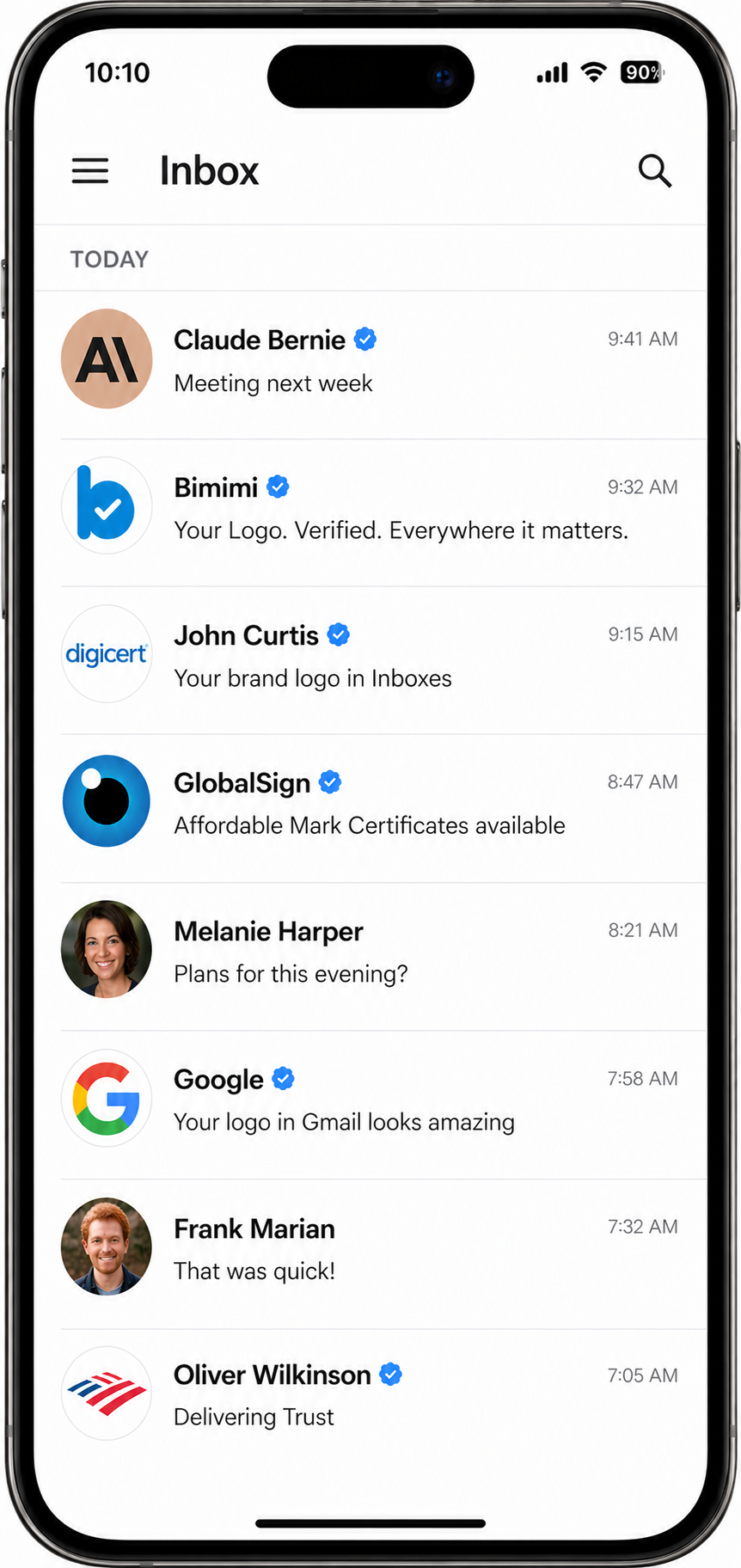
- The Gmail verified checkmark is tied to VMC, not CMC.
BIMI vs CMC vs CMC at a glance
Use this table to understand what each term means, what it requires and when it is the right fit.
Google’s BIMI setup documentation and the BIMI Group’s FAQ support this distinction: BIMI is the framework, VMC is the more rigorous route tied to trademark validation, and CMC is the simplified prior-use alternative.
| TOPIC | BIMI | VMC | CMC |
| What it is | Email logo framework | Verified Mark Certificate | Common Mark Certificate |
| Main role | Enables logo display in supported inboxes | Validates a trademarked logo for BIMI | Validates an eligible prior-use logo for BIMI |
| Trademark required | No | Yes | No |
| Priori use required | No | No | Yes |
| Gmail verified checkmark | No | Yes | No |
| Complexity | Framework-level | Higher | Lower |
| Best for | Brands implementing BIMI | Trademark-backed brands | Eligible non-trademarked brands |
What Is BIMI?
BIMI stands for Brand Indicators for Message Identification. It is the framework that allows a brand-controlled logo to appear in supported email clients when the sending domain passes the required authentication checks. BIMI is not itself a certificate. It is the layer that connects email authentication, hosted logo assets and certificate-based logo validation.
The BIMI Group explains that BIMI enables the use of brand-controlled logos in supporting email clients and relies on DMARC-aligned authentication. Google’s implementation guide also shows that BIMI depends on a VMC or CMC, an SVG logo, hosted PEM-related files and a BIMI TXT record.
What is a VMC?
A VMC, or Verified Mark Certificate, is the premium BIMI certificate path for logos backed by a registered trademark or eligible government mark.
It is the more rigorous certificate type and is intended for brands that want the strongest trust signal available in supported inboxes.
Google explicitly recommends using a VMC whenever possible and states that Gmail shows a checkmark next to senders verified with a VMC.
The BIMI Group also describes VMC as the more rigorous and established certificate type.
What is a CMC?
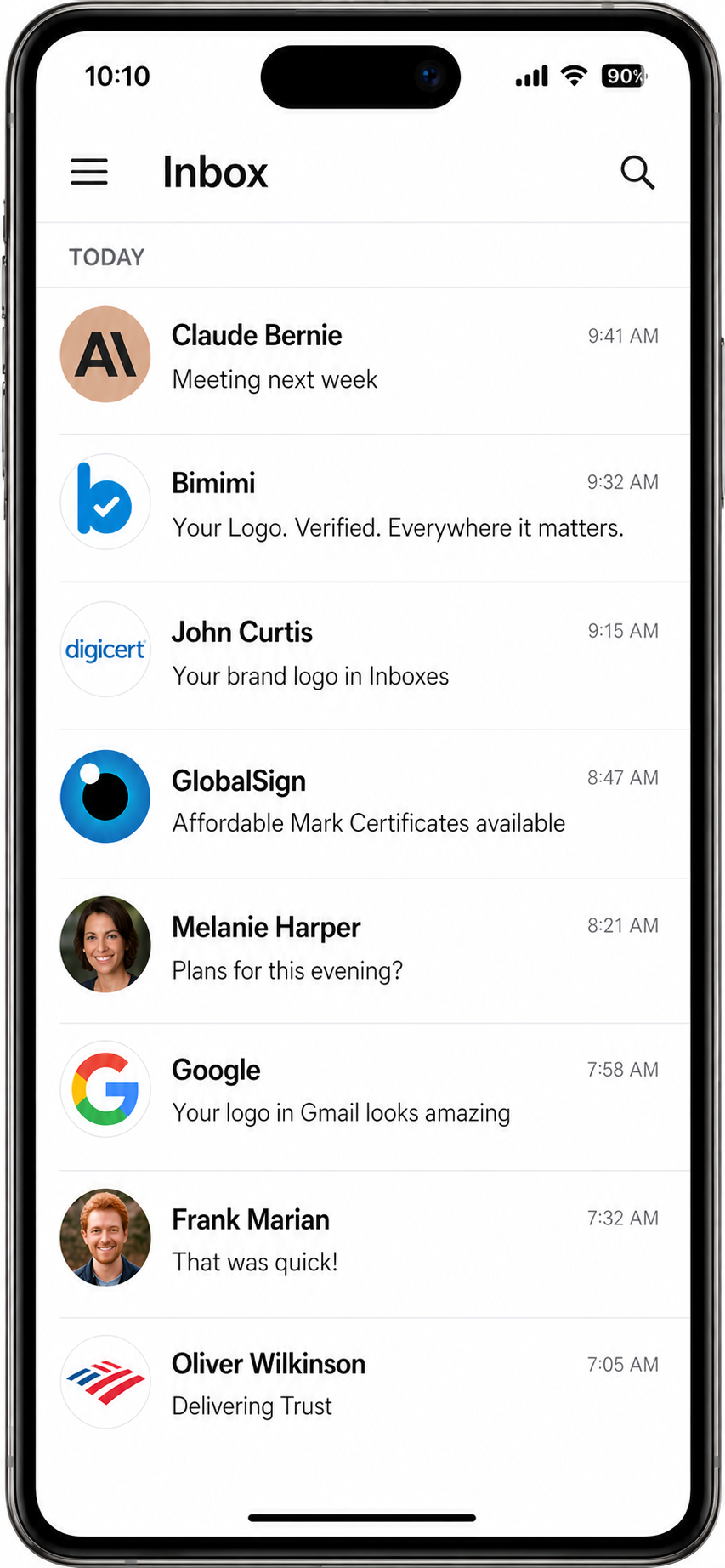
A CMC, or Common Mark Certificate, is the more accessible BIMI certificate path for logos that are not registered trademarks but can be validated through prior use.
It was introduced to reduce cost and complexity while still providing independent validation of the logo used in BIMI.
The BIMI Group describes CMC as a simpler, more streamlined alternative to VMC, designed to make BIMI adoption easier.
It also notes that both VMCs and CMCs validate rights to the mark used in the BIMI logo, but through different validation paths.
How VMC looks like
How CMC looks like
Requirements: VMC vs CMC
Both certificate paths depend on BIMI fundamentals, but the validation path is different.
Google’s official setup guide requires DMARC, compatible hosting and third-party certification for BIMI. The BIMI Group and issuer guidance differentiate VMC and CMC primarily through trademark validation versus prior-use validation.
| Requirement | VMC | CMC |
| DMARC at enforcement | Required | Required |
| BIMI-compatible SVG logo | Required | Requirec |
| Compatible public web hosting | Required | Required |
| Trademarked logo | Required | Not Required |
| Prior-use evidence | Not primary path | Required |
| Gmail verified checkmark | Supported | Not Supported |
Which BIMI Certificate Should You Choose?
Choose BIMI as your starting point
Start here if you are still learning the ecosystem and need to understand the framework before choosing a certificate.
Choose VMC if
Your logo is trademarked, you want the strongest validation route, and you want the Gmail verified checkmark path.
Choose CMC if
Your logo is not trademarked, but you can prove legitimate prior use and want a more accessible route to BIMI deployment.
Where Should You Go Next?
VMC vs CMC vs BIMI FAQ
Is BIMI the same thing as a VMC?
No. BIMI is the framework. A VMC is one of the certificate paths used within BIMI as is CMC.
What is the difference between VMC and CMC?
A VMC is the more rigorous certificate path for trademarked logos. A CMC is the more accessible path for eligible prior-use logos.
Does CMC include the Gmail verified checkmark?
No. Google indicates that the checkmark in Gmail is associated with VMC.
Which certificate should I choose for BIMI?
Choose a VMC if your logo is trademarked and you want the strongest trust signal. Choose a CMC if your logo is not trademarked but qualifies through prior use.
Do both VMC and CMC still require DMARC?
Yes. Google requires DMARC for BIMI regardless of whether you use a VMC or a CMC.